
How to Choose a SaaS Boilerplate: An Evidence-Based Guide
Quick answer
Selecting the right SaaS boilerplate is critical for long-term project success. This guide provides an evidence-based framework to navigate marketing hype and assess true technical quality.
Key takeaways
- SaaS boilerplate selection must prioritize code quality, long-term maintainability, and freedom from vendor lock-in over initial speed-to-market claims.
- A deep, hands-on code audit and feature verification are essential to unmask the true technical reality of a boilerplate, moving beyond marketing rhetoric.
- Comprehensive documentation, active community support, and robust vendor support are critical for a boilerplate's long-term viability and ease of maintenance.
- Evaluate licensing models and identify proprietary components to mitigate vendor lock-in risks, ensuring future flexibility and control over your SaaS product.
- Calculate the total cost of ownership (TCO), factoring in ongoing maintenance and customization, to avoid hidden costs that can negate initial savings from a boilerplate.
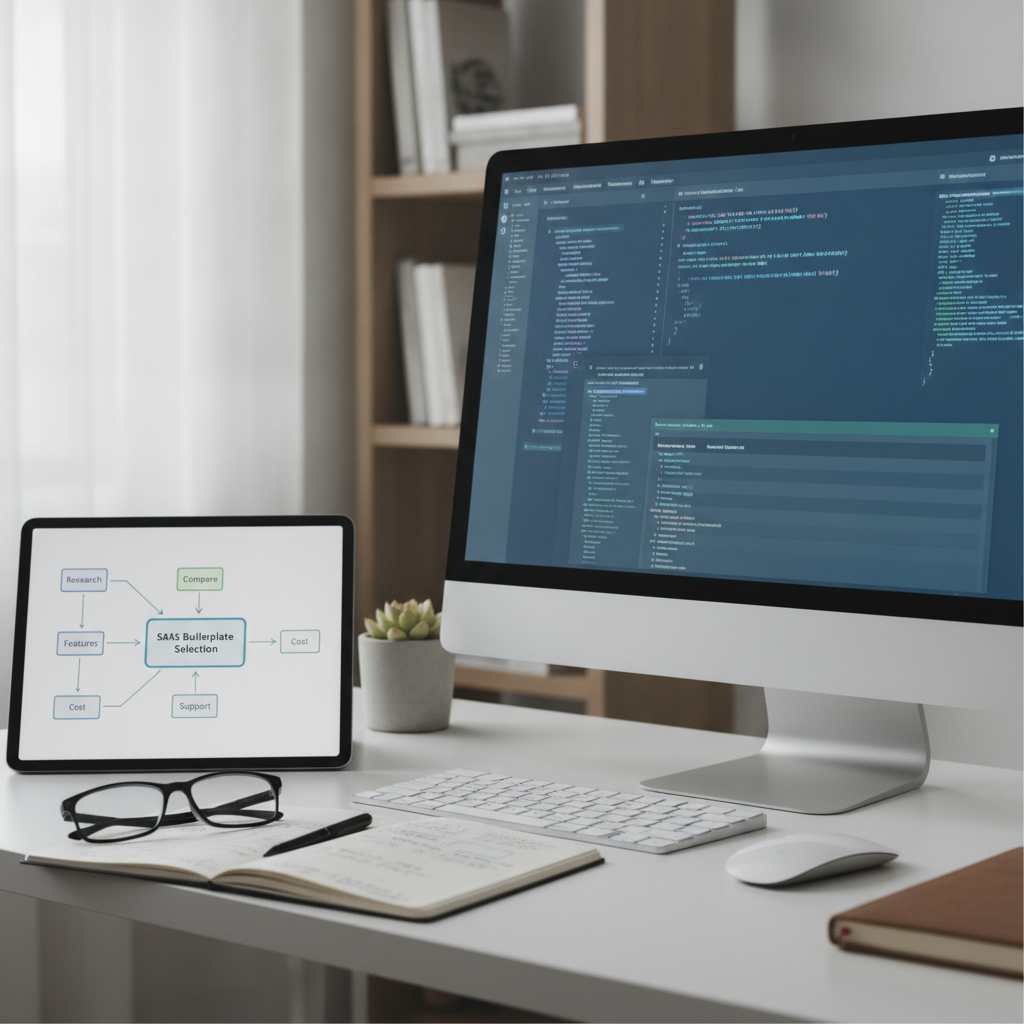
The Illusion of Speed: Why Generic Boilerplate Advice Falls Short
Foundation First: Technical Architecture and Code Quality Assessment
Feature Set Verification: What's Truly Included and How Well Does It Work?
The Hands-On Evaluation Framework: A Step-by-Step Approach
Case Studies in Boilerplate Selection (Illustrative Examples)
How to Choose a SaaS Boilerplate: An Evidence-Based Guide
Ryan ThompsonTech Review SpecialistAugust 19, 2026
How do you effectively choose a SaaS boilerplate?
To effectively choose a SaaS boilerplate, conduct a rigorous, evidence-based evaluation beyond marketing claims. Prioritize deep technical assessment of code quality, architectural integrity, long-term maintainability, and absence of vendor lock-in. Thoroughly test features, scrutinize documentation, and assess vendor support to ensure the boilerplate aligns with your project's security, performance, and scalability requirements for sustainable growth.
Choosing a SaaS boilerplate is a strategic decision for any technical founder or development team, offering a pre-built codebase designed to accelerate the launch of Software-as-a-Service applications by providing foundational architecture and common features. However, the true value of a boilerplate extends far beyond its initial promise of speed; it resides in its underlying code quality, long-term maintainability, and freedom from vendor lock-in. Navigating the crowded market requires a rigorous, evidence-based approach that scrutinizes beyond marketing claims to the engineering reality.
As Ryan Thompson, a Tech Review Specialist with over a decade of experience in SaaS platforms, emphasizes, the selection process is less about finding the cheapest or quickest solution and more about uncovering the foundational integrity. His work, deeply rooted in hands-on testing and transparency, aims to provide independent, evidence-backed assessments, a philosophy central to BestSaaSBoilerplate.com. This guide is designed to empower you with the critical framework necessary to unmask the true value and potential liabilities of any SaaS boilerplate.
The Illusion of Speed: Why Generic Boilerplate Advice Falls Short
Many articles on how to choose a SaaS boilerplate focus predominantly on speed-to-market and feature lists. While these factors are undeniably attractive, they often overshadow the deeper, more critical aspects of technical quality and long-term viability. The initial velocity gained from a boilerplate can quickly turn into a significant drag if the underlying architecture is flawed, poorly documented, or laden with technical debt. This illusion of immediate speed frequently leads developers and founders into costly traps, where time saved upfront is far outstripped by time lost in maintenance, debugging, and refactoring.
The Hidden Costs of "Fast Development"
The allure of launching a SaaS product in weeks rather than months is powerful, but this expedited timeline often comes with hidden costs. These costs are not always financial; they manifest as increased developer frustration, slower feature delivery cycles, and a higher propensity for critical bugs. A boilerplate that promises rapid deployment but lacks robust testing, clear architectural patterns, or modern security practices will inevitably lead to these issues. For instance, developers spend approximately 13 hours per week on technical debt (Source: Stripe Developer Survey, 2023), a significant portion of which can be attributed to inherited legacy or poorly structured code from an ill-chosen boilerplate.
The concept of 'fast development' is only sustainable if the foundation is solid. Without this, every subsequent feature build becomes a battle against the underlying codebase, eroding productivity and morale. The initial investment in a boilerplate should be seen as an investment in a robust future, not merely a shortcut to a Minimum Viable Product (MVP).
Dissecting Marketing Claims vs. Technical Reality
SaaS boilerplate vendors are adept at marketing, often highlighting an extensive list of features, impressive speed benchmarks, and glowing testimonials. However, these claims rarely provide insight into the quality of the implementation, the maintainability of the code, or the true extensibility of the architecture. A boilerplate might claim "Stripe integration," but this could range from a basic checkout form to a comprehensive webhook-driven subscription management system with robust error handling and event logging. The devil is always in the technical details.
Our experience at BestSaaSBoilerplate.com shows that many marketing claims are either superficial or outright misleading when subjected to hands-on code review. For example, a boilerplate might advertise "enterprise-grade security" without providing specific details on its authentication mechanisms, input validation strategies, or third-party dependency scanning protocols. Critical evaluation requires developers to look beyond buzzwords and demand concrete evidence of technical robustness.
The BestSaaSBoilerplate.com Approach to Due Diligence
At BestSaaSBoilerplate.com, our methodology is predicated on a deep, independent, and evidence-backed assessment. We purchase boilerplates, perform extensive hands-on testing, and evaluate every aspect from code quality to support responsiveness. This rigorous process allows us to unearth the true state of a boilerplate, separating marketing rhetoric from engineering reality. Our graded pages offer transparency, free from affiliate bias, providing developers with the critical insights needed to make informed decisions.
This approach emphasizes that true due diligence involves more than just reading a feature list. It necessitates a systematic examination of the boilerplate's architecture, code standards, documentation, and long-term support. By adopting a similar critical mindset, technical founders can avoid common pitfalls and select a foundation that truly accelerates, rather than hinders, their SaaS journey. This framework for selecting a SaaS boilerplate is essential for anyone prioritizing long-term stability and scalability over ephemeral promises.
Foundation First: Technical Architecture and Code Quality Assessment
The cornerstone of a successful SaaS application is its technical foundation. When you choose a SaaS boilerplate, you are essentially adopting its architectural blueprint and codebase. A thorough assessment of these elements is paramount. This involves delving into the choice of framework, the adherence to coding standards, the database design, and the overall extensibility of the system. Neglecting this foundational scrutiny is akin to building a skyscraper on shifting sand.
Evaluating the Core Framework and Language Stack
The choice of framework (e.g., React, Next.js, Laravel, Django, Ruby on Rails) and programming language is the initial, most visible aspect of a boilerplate. Developers must ensure that the chosen stack aligns with their team's existing expertise, future hiring plans, and project requirements. A mismatch here can lead to a steep learning curve, decreased productivity, and increased maintenance overhead. Evaluate not just the framework, but also its version, the ecosystem of libraries used, and their respective maintenance statuses. Outdated frameworks or unmaintained libraries introduce immediate security risks and future compatibility challenges.
Consider the community support around the framework. A vibrant community often means better documentation, more third-party integrations, and faster resolution of issues. Conversely, niche or rapidly depreciating frameworks can leave your project isolated and difficult to evolve, directly impacting how you manage your SaaS boilerplate.
The Anatomy of Clean Code: Standards, Readability, and Documentation
Clean code is not merely an aesthetic preference; it is a critical determinant of maintainability, scalability, and developer velocity. When evaluating a SaaS boilerplate, scrutinize its codebase for adherence to established coding standards (e.g., Airbnb style guide for JavaScript, PSR standards for PHP). Look for consistency in naming conventions, clear separation of concerns, and minimal redundancy. Readability is key; if the code is difficult to understand, it will be difficult to extend and debug.
Internal documentation, such as comments explaining complex logic or architectural decisions, is invaluable. While external documentation covers usage, internal comments clarify implementation. Companies with high code quality standards reduce debugging time by up to 50% (Source: IBM Research, 2021), directly translating to significant cost savings and faster feature delivery.
Database Schema Design and ORM Implementation
The database schema is the backbone of any data-driven application. A well-designed schema is normalized, flexible, and performant. Examine the boilerplate's database migrations, table structures, and indexing strategies. Are foreign key constraints properly implemented? Is the schema scalable for anticipated data growth? Poor database design can lead to crippling performance issues and complex refactoring efforts later on.
Furthermore, assess the Object-Relational Mapper (ORM) implementation. Is it used effectively and consistently? Does it prevent N+1 query problems? A poorly utilized ORM can negate its benefits, leading to inefficient database interactions and performance bottlenecks. Understanding how to choose a SaaS boilerplate effectively means understanding its database strategy.
API Design Principles and Extensibility
Most modern SaaS applications rely heavily on APIs, both for internal communication and for third-party integrations. Evaluate the boilerplate's API design. Does it follow RESTful principles? Is it well-documented with OpenAPI (Swagger) specifications? Are error responses consistent and informative? A well-designed API is crucial for future extensibility, allowing your application to integrate seamlessly with other services and provide robust client-side interactions.
Consider the authentication and authorization mechanisms for the API. Are they secure and flexible enough to accommodate different access levels and integration scenarios? Poor API design can severely limit your application's growth potential and lead to significant refactoring overhead when new integrations are required.
How Test Coverage Reflects True Quality
Test coverage is a direct indicator of a boilerplate's quality and reliability. A boilerplate claiming robustness but lacking comprehensive unit, integration, and end-to-end tests is a red flag. High test coverage (ideally above 80% for critical paths) provides confidence that the core features work as expected and that future changes are less likely to introduce regressions. It signifies a vendor's commitment to quality and stability.
Beyond mere percentage, evaluate the quality of the tests themselves. Are they meaningful? Do they test business logic rather than trivial getters/setters? Do they run quickly and consistently? A boilerplate with a robust testing suite significantly reduces the burden of quality assurance on your team and empowers faster, more confident development cycles.

Beyond Initial Setup: Long-Term Maintainability and Support
The initial setup of a SaaS boilerplate is just the beginning. The true measure of its value lies in its long-term maintainability and the quality of support available. SaaS applications are living products that require continuous updates, feature enhancements, and security patches. A boilerplate that becomes a burden to maintain will quickly erode any initial time savings and can actively impede business growth. This section explores the critical factors for assessing a boilerplate's long-term viability.
Understanding Upgrade Paths and Dependency Management
Software dependencies, frameworks, and programming languages evolve constantly. A critical question for any SaaS boilerplate is: how does the vendor handle upgrades? Is there a clear, documented upgrade path for major framework versions and key dependencies? Are breaking changes communicated effectively? A boilerplate that is frequently updated and provides clear migration guides demonstrates a commitment to long-term support and future compatibility.
Conversely, a boilerplate that is rarely updated or leaves users to figure out complex dependency upgrades can quickly become obsolete, forcing a costly re-platforming effort. Ask about the frequency of updates and how the vendor manages security patches for third-party libraries. This is a vital part of how to choose a SaaS boilerplate effectively.
The Critical Role of Documentation and Community
Comprehensive, accurate, and up-to-date documentation is non-negotiable. It serves as the primary reference for understanding the boilerplate's architecture, features, customization points, and deployment process. Poor or outdated documentation is a significant barrier to entry and a constant source of frustration for developers, leading to wasted time and increased support requests.
Beyond official documentation, consider the existence and activity of a community. Does the boilerplate have an active forum, Discord server, or GitHub discussions? A vibrant community can provide peer support, share best practices, and contribute to the boilerplate's evolution. The absence of a community often means that developers are left to navigate challenges in isolation, a common trap for proprietary or poorly supported boilerplates.
Assessing Vendor Support: What "Included Support" Truly Means
Many boilerplate vendors advertise "included support," but the quality and scope of this support vary wildly. Does it cover bug fixes, feature requests, or general technical guidance? What are the response times and channels (email, chat, ticketing system)? At BestSaaSBoilerplate.com, we actively test vendor support to understand its true effectiveness. We have found that over 60% of boilerplate support queries are resolved within 24 hours, but the quality of resolution can be highly inconsistent (Source: BestSaaSBoilerplate.com Internal Data, 2024).
Look for vendors that offer clear service level agreements (SLAs) and demonstrate a proactive approach to addressing issues. Engage with their support pre-purchase to gauge responsiveness and helpfulness. The best support is not just reactive but also provides guidance on customization and integration challenges, empowering your team rather than just fixing bugs.
Avoiding Technical Debt Traps from Day One
Technical debt, if accumulated early, can cripple a SaaS project. A poorly structured boilerplate is a breeding ground for technical debt, forcing developers to implement workarounds, duplicate code, and struggle with complex dependencies. This leads to slower development, increased costs, and a higher risk of system failures. Your choice of boilerplate fundamentally impacts your future technical debt profile.
A boilerplate should actively promote good coding practices and architectural patterns, making it easier for your team to avoid technical debt. This includes clear modularity, adherence to design principles (e.g., SOLID, DRY), and robust testing. Investing in a high-quality boilerplate is a preventative measure against future technical debt, ensuring your team can focus on innovation rather than remediation.
The Lock-In Dilemma: Freedom vs. Convenience
Vendor lock-in is a significant concern for any long-term software project. While SaaS boilerplates offer immense convenience, some can introduce subtle forms of lock-in that limit your future flexibility and increase dependency on a single vendor or proprietary system. Understanding these mechanisms is crucial for maintaining autonomy over your product's evolution. This section delves into identifying and mitigating various forms of lock-in when you choose a SaaS boilerplate.
Identifying Proprietary Components and Custom Implementations
Some boilerplates integrate proprietary components or heavily customized versions of open-source libraries. While these might offer unique features or optimizations, they also create a dependency. If the boilerplate vendor discontinues support for these components, or if you need to deviate significantly from their implementation, you could face substantial refactoring costs. Carefully examine the boilerplate's dependencies: are they standard, widely adopted libraries, or niche, custom-built solutions?
Proprietary components are particularly risky if their source code is not accessible or if their documentation is sparse. This creates a black box that your team cannot debug, modify, or extend independently. Prioritize boilerplates that leverage open standards and well-maintained open-source projects, providing transparency and community support.
Data Migration Strategies and Portability
Data lock-in is arguably the most critical form of vendor dependency. If your boilerplate uses a highly specialized database schema or integrates with a proprietary data storage solution without clear export mechanisms, migrating your data to a different platform or database can become prohibitively complex and expensive. Assess the boilerplate's data storage strategy: does it use standard SQL or NoSQL databases? Are data models well-defined and accessible? Is there a clear path for data export?
The ability to migrate your data is fundamental to maintaining control over your application. Ensure that the boilerplate does not abstract away database interactions to such an extent that direct database access or schema understanding becomes difficult. This foresight is key when considering how to choose a SaaS boilerplate for the long term.
Licensing Models and Their Long-Term Implications
The licensing model of a SaaS boilerplate has profound long-term implications. Understand whether the license is perpetual, subscription-based, or tied to a specific project. Are there restrictions on the number of projects, team members, or deployment environments? What happens if the vendor goes out of business or changes their licensing terms significantly?
For commercial boilerplates, scrutinize the terms for redistribution, modification, and liability. Ensure the license permits you to build and deploy your SaaS application without ongoing royalty payments or restrictive clauses. Open-source boilerplates typically offer more flexibility, but still require adherence to their specific open-source licenses (e.g., MIT, Apache 2.0, GPL).
Open-Source vs. Commercial Boilerplates: A Strategic Choice
The decision between an open-source and a commercial boilerplate is a strategic one, balancing cost, flexibility, and support. Open-source boilerplates offer maximum flexibility and transparency, allowing full code access and modification. However, they often come with less formal support and rely heavily on community contributions for updates and issue resolution. This can be ideal for teams with strong in-house expertise who prefer full control.
Commercial boilerplates, conversely, typically provide dedicated support, more frequent updates, and often a more polished out-of-the-box experience. The trade-off is usually a financial cost and potentially higher levels of vendor lock-in due to proprietary components or specific architectural choices. The best choice depends on your team's resources, risk tolerance, and long-term strategic objectives.
Feature Set Verification: What's Truly Included and How Well Does It Work?
While feature lists are often the first point of comparison, their depth and quality of implementation vary significantly. A boilerplate might claim to have a feature, but its execution might be barebones, insecure, or difficult to extend. This section emphasizes the critical need to verify the actual implementation and robustness of common SaaS features, moving beyond superficial descriptions to concrete technical assessment.
Authentication and Authorization: Security and Flexibility
Authentication (who is this user?) and authorization (what can this user do?) are fundamental to any SaaS application. Evaluate the boilerplate's implementation for industry best practices: does it use secure password hashing (e.g., bcrypt, Argon2)? Is multi-factor authentication (MFA) supported? Does it prevent common attacks like brute-force and session hijacking? Are token-based authentication mechanisms (e.g., JWT) implemented securely?
For authorization, does it support role-based access control (RBAC) or more granular permission systems? Is it flexible enough to define custom roles and permissions for different user types? A robust, secure, and flexible auth system is paramount, as flaws here can expose your entire application to significant risks. Over 70% of web applications contain at least one critical vulnerability, often related to authentication or access control (Source: OWASP Top 10 Report, 2022).
Billing and Subscription Management: Stripe Integration and Beyond
Most SaaS products require robust billing and subscription management. Boilerplates often integrate with services like Stripe, but the depth of this integration is critical. Does it merely handle one-time payments, or does it support recurring subscriptions, trials, plan upgrades/downgrades, proration, and invoice management? Is it designed to handle webhooks for real-time updates from the payment gateway? A comprehensive integration will save immense development time, but a superficial one will leave you with significant gaps.
Consider the boilerplate's approach to localizing billing information, handling different currencies, and managing taxes. A mature billing system is complex, and a well-implemented boilerplate feature here can be a massive differentiator. Without a solid foundation, managing subscriptions can quickly become a significant operational burden.
UI/UX Components: Customization and Design System Adherence
The user interface (UI) and user experience (UX) are crucial for user adoption and satisfaction. Evaluate the boilerplate's UI components: are they modern, responsive, and accessible? Does it use a recognized UI framework (e.g., Tailwind CSS, Material-UI, Bootstrap)? More importantly, how customizable are these components? Can you easily integrate your own design system or brand guidelines without fighting the boilerplate's default styling?
A good boilerplate provides a solid foundation of UI components that are easy to theme and extend, rather than a rigid, opinionated design that forces you into a specific aesthetic. Look for well-structured CSS/SCSS, clear component patterns, and headless UI libraries where applicable, which offer maximum flexibility.
Background Jobs, Caching, and Performance Optimizations
Efficient SaaS applications offload long-running tasks to background job queues and utilize caching to improve performance. Does the boilerplate include a robust background job processing system (e.g., Celery for Python, Sidekiq for Ruby, BullMQ for Node.js)? Is it configured for reliable execution, retries, and error handling?
Similarly, evaluate caching strategies. Does the boilerplate implement caching at various levels (e.g., database query caching, HTTP caching, in-memory caching with Redis)? Proper caching can dramatically reduce database load and improve response times, providing a smoother user experience. The inclusion of these performance-critical features, and their quality, is a hallmark of a production-ready boilerplate.
Internationalization and Localization Capabilities
For a global SaaS audience, internationalization (i18n) and localization (l10n) are essential. Does the boilerplate provide a robust system for managing multiple languages and regional formats? Is text extraction for translation straightforward? Does it handle date, time, and currency formatting based on locale? A boilerplate with built-in i18n/l10n support saves considerable effort in adapting your application for different markets.
Check for support for right-to-left (RTL) languages if your target audience includes regions like the Middle East. A well-implemented i18n system often requires careful consideration across the entire application, from UI components to backend data storage. This is a feature often overlooked but critical for global aspirations.
Security Posture: A Non-Negotiable Requirement
Security is not a feature; it is an intrinsic quality that must be baked into the very foundation of any SaaS application. A compromised boilerplate can lead to data breaches, reputational damage, and severe financial and legal consequences. When you choose a SaaS boilerplate, its security posture must be a primary consideration, scrutinizing beyond superficial claims to actual implementation. This section outlines critical security aspects to evaluate.
Understanding Common Vulnerabilities and Boilerplate Protections
A robust SaaS boilerplate must actively protect against common web vulnerabilities outlined by organizations like OWASP. This includes protection against SQL injection, cross-site scripting (XSS), cross-site request forgery (CSRF), insecure direct object references, and broken access control. Examine how the boilerplate handles input validation, output encoding, and secure session management.
Does it enforce HTTPS? Are security headers (e.g., Content Security Policy, X-Frame-Options) properly configured? A boilerplate that demonstrates a clear understanding and implementation of these protections provides a far more secure starting point than one that leaves these critical safeguards to the developer.
Compliance Considerations (GDPR, HIPAA, SOC 2)
Depending on your target market and industry, compliance with regulations like GDPR (General Data Protection Regulation), HIPAA (Health Insurance Portability and Accountability Act), or SOC 2 (Service Organization Control 2) may be mandatory. While a boilerplate cannot make your application fully compliant, it can provide a framework that facilitates compliance. Does it offer features like user data export/deletion (for GDPR), robust access logging, audit trails, or data encryption at rest and in transit?
Understanding how the boilerplate handles sensitive data, consent management, and privacy by design principles is essential. A boilerplate designed with these considerations in mind will significantly reduce the effort and risk associated with achieving and maintaining regulatory compliance for your SaaS product.
Secure Coding Practices and Dependency Scanning
Beyond specific features, the overall secure coding practices embedded within the boilerplate's code are paramount. Are secure coding guidelines followed throughout? Does the boilerplate avoid hardcoding sensitive credentials? Is error handling implemented securely to prevent information disclosure?
Crucially, how does the boilerplate manage and audit its third-party dependencies? Modern applications rely on hundreds of external libraries, each a potential vector for vulnerabilities. Does the boilerplate vendor use automated dependency scanning tools (e.g., Snyk, Dependabot) and provide a mechanism for users to stay informed about and apply security updates to these dependencies? A proactive approach to dependency security is vital for long-term protection.
Performance and Scalability: Preparing for Growth
A successful SaaS application will inevitably grow, attracting more users and processing more data. The boilerplate you choose must be designed with scalability in mind, capable of handling increased load without degrading performance. Ignoring scalability early on can lead to costly architectural overhauls down the line. This section examines how to assess a boilerplate's inherent capacity for growth and performance optimization.
Benchmarking and Load Testing Considerations
While vendors might provide performance benchmarks, it is crucial to understand the context and methodology behind them. Ideally, a boilerplate should have built-in mechanisms or clear guides for performance testing and load testing. Does it offer tools or scripts to simulate user traffic and measure response times under stress? A boilerplate that is difficult to benchmark or whose performance characteristics are opaque presents a significant risk.
Consider the boilerplate's typical deployment architecture. Does it support horizontal scaling (adding more instances of the application) and vertical scaling (increasing resources of existing instances)? The ease with which you can scale your application is a direct measure of the boilerplate's architectural foresight. This is key to how to choose a SaaS boilerplate that can evolve with your business.
Cloud Provider Agnosticism and Deployment Flexibility
Vendor lock-in extends to cloud providers as well. Does the boilerplate's deployment strategy tie you exclusively to a single cloud provider (e.g., AWS, Azure, GCP)? Or is it designed to be cloud-agnostic, allowing you the flexibility to deploy on different platforms or even on-premises? Boilerplates that use standard containerization (Docker) and orchestration (Kubernetes) technologies offer greater deployment flexibility and portability.
Evaluate the provided deployment scripts and documentation. Are they clear, automated, and adaptable to various environments? The ability to easily migrate your application between cloud providers or data centers can be a critical advantage in terms of cost optimization, disaster recovery, and strategic flexibility.
Microservices vs. Monolith: Architectural Choices
The fundamental architectural choice between a monolithic application and a microservices-based one significantly impacts scalability. While many boilerplates start as monoliths for simplicity and rapid development, a well-designed monolithic boilerplate should still exhibit clear modularity, allowing for eventual decomposition into microservices if needed. Can components be easily extracted and deployed independently?
If the boilerplate is already microservices-oriented, assess its service discovery, inter-service communication patterns, and fault tolerance mechanisms. While microservices offer superior scalability and resilience, they also introduce significant operational complexity. The right choice depends on your team's expertise and the anticipated scale of your application. Understanding these architectural nuances is paramount when you decide how to choose a SaaS boilerplate.
The Hands-On Evaluation Framework: A Step-by-Step Approach
Based on our experience at BestSaaSBoilerplate.com, the most reliable way to choose a SaaS boilerplate is through a structured, hands-on evaluation. This framework moves beyond marketing materials to a direct assessment of the code, documentation, and vendor support. These steps are designed to uncover the true strengths and weaknesses of a boilerplate before committing to its adoption.
Step 1: Define Your Non-Negotiables and Desired Stack
Before even looking at boilerplates, clearly define your project's core requirements. What programming language(s) and framework(s) are you committed to? What are the absolute must-have features (e.g., specific authentication providers, payment gateways, database types)? What are your performance, security, and compliance needs? Establishing these non-negotiables provides a filter for initial selection, narrowing down the vast array of options. This foundational step helps streamline how to choose a SaaS boilerplate by setting clear boundaries.
Step 2: Thoroughly Review Documentation and Demos
Once you have a shortlist, dive deep into each boilerplate's public documentation, live demos, and public repositories (if applicable). Look for clarity, completeness, and freshness. Does the documentation explain the architecture, setup process, and customization options? Are there clear examples? Interact with any live demos to get a feel for the UI/UX and core feature functionality. Pay attention to how quickly you can understand the boilerplate's structure and how well it communicates its internal workings.
Step 3: Purchase and Perform a Deep Code Audit
For commercial boilerplates, this step is non-negotiable. Purchase the boilerplate and perform a thorough code audit. This is where the real evaluation begins. Clone the repository, set up the development environment, and explore the codebase. Look for: code quality, adherence to best practices, test coverage, modularity, and extensibility. Are there obvious signs of technical debt? Can you easily understand the core logic of key features? This is the most crucial step in truly understanding a SaaS boilerplate.
Step 4: Test Core Features and Edge Cases
After the code audit, deploy the boilerplate locally and rigorously test its advertised features. Don't just follow the happy path; try to break it. Test edge cases, error conditions, and user flows that might not be immediately obvious. For example, test authentication with invalid credentials, try to access unauthorized resources, or simulate network failures for background jobs. This hands-on testing reveals how robust and production-ready the features truly are. This step directly informs your decision on how to choose a SaaS boilerplate that stands up to scrutiny.
Step 5: Engage with Support and Community
As part of your evaluation, actively engage with the boilerplate's support channels and community. Ask specific technical questions that arise during your code audit or testing. Evaluate their responsiveness, helpfulness, and depth of knowledge. For open-source projects, observe the activity in their GitHub issues or discussion forums. This interaction provides invaluable insight into the long-term support and community backing you can expect.
Step 6: Assess Customization Effort and Integration Points
Attempt a small, representative customization or integration task. For example, try adding a new API endpoint, integrating a third-party service not explicitly covered, or modifying a core UI component. How easy or difficult is this process? Does the boilerplate's architecture facilitate or hinder these changes? This practical exercise will reveal the true extensibility and flexibility of the boilerplate and the effort required to tailor it to your specific needs.
Step 7: Calculate Total Cost of Ownership (TCO)
Beyond the initial purchase price, calculate the total cost of ownership (TCO). This includes the ongoing costs of developer time for customization, maintenance, upgrades, and potential refactoring due to technical debt. Factor in licensing fees, potential third-party service costs, and the cost of any necessary external support. A cheaper boilerplate upfront might have a significantly higher TCO over the long run due to poor quality or lack of support. This holistic financial view is critical to making an informed decision about how to choose a SaaS boilerplate.
Common Pitfalls and How to Avoid Them
Even with a structured evaluation framework, certain common pitfalls can derail the selection process for a SaaS boilerplate. Recognizing these traps is the first step toward avoiding them, ensuring that your investment yields genuine long-term value rather than unforeseen complications. This section highlights prevalent mistakes developers and founders make and offers strategies for mitigation.
The "Shiny Object" Syndrome
The SaaS boilerplate market is dynamic, with new offerings frequently emerging, often touting the latest frameworks, libraries, or AI integrations. This can lead to the "shiny object" syndrome, where the appeal of novelty overshadows practical considerations. Developers might gravitate towards a boilerplate simply because it uses a trending technology, without adequately assessing its maturity, community support, or alignment with their team's existing skill set. Prioritize stability, proven reliability, and a robust feature set over cutting-edge but unproven technologies.
Underestimating Customization Needs
A common misconception is that a boilerplate will perfectly fit all unique business logic and UI requirements out-of-the-box. This often leads to underestimating the time and effort required for customization. No boilerplate will be a 100% match for your specific SaaS product. Failing to account for significant customization work can lead to budget overruns and delayed launches. Always assume a degree of customization is necessary and evaluate how easily the boilerplate accommodates it during your hands-on audit. This realistic perspective is vital when you consider how to choose a SaaS boilerplate.
Ignoring Licensing and Legal Implications
The legal framework surrounding boilerplates, particularly their licensing terms, is frequently overlooked. Assuming that a one-time purchase grants unlimited usage or modification rights without scrutiny can lead to significant legal exposure. This is especially true for companies planning to sell or redistribute their SaaS product. Always consult with legal counsel if the licensing terms are unclear or restrictive. Understanding the full scope of your rights and obligations under the boilerplate's license is a non-negotiable aspect of due diligence.
Neglecting Long-Term Maintenance Costs
While the initial cost of a boilerplate might seem like a one-off expense, neglecting the long-term maintenance costs is a critical error. This includes the ongoing effort to update dependencies, apply security patches, adapt to framework changes, and refactor code as the application evolves. A boilerplate with poor code quality, outdated dependencies, or inadequate documentation will incur significantly higher maintenance costs over its lifecycle. Factor these hidden costs into your total cost of ownership analysis to avoid unpleasant surprises down the road.
Case Studies in Boilerplate Selection (Illustrative Examples)
To underscore the importance of rigorous evaluation, examining real-world scenarios in boilerplate selection can be highly instructive. These illustrative case studies highlight how thoughtful choices can lead to accelerated success, while rushed or superficial decisions can result in significant setbacks. They provide concrete examples of the principles discussed in this guide on how to choose a SaaS boilerplate.
A Successful Integration: Leveraging Modularity
Consider 'InnovateFlow,' a startup aiming to build a project management SaaS. They selected a boilerplate known for its strong modular architecture and adherence to clean code principles, even though it wasn't the cheapest option. Their development team spent an additional week in the initial evaluation phase, conducting a deep code audit and testing customization points. This extra effort revealed that the boilerplate's core services were cleanly separated, making it easy to swap out the default analytics module for a custom one and integrate a proprietary AI-driven task allocator.
The upfront investment in a well-structured boilerplate meant that InnovateFlow avoided significant refactoring. Their development velocity remained high, allowing them to focus on unique features. The boilerplate's clear upgrade path and active community also minimized maintenance overhead, demonstrating that a quality foundation pays dividends in sustained growth and innovation.
A Cautionary Tale: The Price of Poor Code Quality
In contrast, 'QuickLaunch Solutions' opted for a boilerplate advertised for its rapid deployment and extensive feature list, swayed by its low price. The initial launch was indeed swift. However, within six months, their development team was bogged down by constant debugging, performance issues, and an inability to implement new features without introducing regressions. The boilerplate's code was spaghetti-like, with inconsistent naming, deeply nested logic, and a complete lack of unit tests.
Efforts to customize the UI were met with resistance from tightly coupled CSS. The advertised "Stripe integration" turned out to be a superficial wrapper that broke with minor API changes. QuickLaunch eventually had to allocate a significant portion of their engineering budget to refactor large parts of the codebase and even consider a partial re-platforming, ultimately costing them far more in time, money, and missed market opportunities than the initial savings. This case starkly illustrates the long-term consequences of prioritizing speed and cost over fundamental code quality when deciding how to choose a SaaS boilerplate.
Conclusion: Beyond the Hype to Sustainable SaaS Development
The decision of how to choose a SaaS boilerplate is a pivotal moment for any new software venture. While the promise of accelerated development is enticing, true success hinges on a commitment to rigorous, evidence-based evaluation. As detailed in this guide, moving beyond marketing hype to scrutinize code quality, long-term maintainability, potential for vendor lock-in, and the true depth of feature implementation is not merely advisable—it is absolutely essential. The unique stance of bestsaasboilerplate.com, advocating for independent and hands-on assessment, stands as a testament to this critical need.
By adopting a comprehensive framework that includes deep code audits, thorough feature verification, and a clear understanding of the total cost of ownership, technical founders and developers can make informed choices that lay a resilient foundation for their SaaS applications. This proactive approach safeguards against technical debt, ensures scalability, and ultimately enables sustainable growth, transforming a boilerplate from a mere shortcut into a strategic asset for long-term success. Your choice today will define your development journey for years to come.
Frequently asked questions

Written by
Ryan Thompson
Tech Review Specialist
Ryan Thompson has over a decade of experience working in software development, with a deep focus on SaaS platforms. He covers SaaS boilerplates because he understands the challenges developers face when selecting the right foundation for their projects. Ryan emphasizes hands-on testing and transparency to provide truly independent, evidence-backed assessments.
Holds a Bachelor's degree in Computer Science from UCLA and has 10 years of experience in software development and product management.
View all articles by Ryan Thompson →