
AI SaaS Boilerplate: Unveiling Hidden Costs & Code Quality
Quick answer
Explore the true value of AI SaaS boilerplates, focusing on long-term maintenance, vendor lock-in, and the critical importance of code quality from an independent audit perspective.
Key takeaways
- Many AI SaaS boilerplates overpromise on 'out-of-the-box' AI, often leading to significant technical debt and vendor lock-in due to tightly coupled, opaque integrations.
- Independent code quality audits, like those performed by BestSaaSBoilerplate.com, are crucial for identifying hidden costs, poor architectural decisions, and long-term maintenance liabilities in AI boilerplates.
- True value in an AI SaaS boilerplate lies in its modularity, extensibility, and the clarity of its AI integration layers, allowing for future model evolution and data strategy shifts.
- Developers must critically evaluate boilerplates for real support, honest claims, and the absence of hidden dependencies that can severely limit customization and introduce unexpected costs.
- Ethical AI considerations, data privacy compliance (e.g., GDPR, CCPA), and robust security practices are non-negotiable features that define a responsible and future-proof AI SaaS boilerplate.

The Deceptive Promise of "Out-of-the-Box" AI SaaS Boilerplates
Decoding the Core Components of a Robust AI SaaS Boilerplate
The Critical Imperative: Evaluating Code Quality and Modularity in AI Boilerplates
Beyond the Hype: Addressing Vendor Lock-in and Long-Term Maintainability
Navigating Ethical AI, Data Privacy, and Security in Boilerplate Solutions
Choosing Wisely: An Independent Framework for AI SaaS Boilerplate Selection
Conclusion: Building the Future of AI SaaS with Informed Decisions
AI SaaS Boilerplate: Unveiling Hidden Costs & Code Quality
Ryan ThompsonTech Review SpecialistAugust 24, 2026
What is an AI SaaS boilerplate?
An AI SaaS boilerplate is a pre-built codebase and infrastructure foundation designed to accelerate the development of Software-as-a-Service applications integrating artificial intelligence capabilities. It typically includes core SaaS features like authentication, billing, and database management, alongside pre-configured AI model integrations, data pipelines, and relevant APIs, enabling developers to bypass repetitive setup and focus on unique application logic.
An AI SaaS boilerplate is a pre-built codebase and infrastructure foundation designed to accelerate the development of Software-as-a-Service applications integrating artificial intelligence capabilities. It typically includes core SaaS features like authentication, billing, and database management, alongside pre-configured AI model integrations, data pipelines, and relevant APIs, enabling developers to bypass repetitive setup and focus on unique application logic. However, the true value and long-term viability of these solutions often diverge significantly from initial marketing promises, presenting hidden costs, vendor lock-in, and substantial technical debt if not meticulously evaluated. This guide, drawing on over a decade of software development experience and the rigorous, hands-on testing methodology of BestSaaSBoilerplate.com, aims to equip developers, technical founders, indie hackers, and engineering teams with the critical insights needed to navigate this complex landscape.
The Deceptive Promise of "Out-of-the-Box" AI SaaS Boilerplates
The allure of an AI SaaS boilerplate often stems from the promise of rapid deployment and immediate AI functionality. Marketing materials frequently highlight pre-integrated models and expedited development cycles, suggesting a path to market that bypasses significant engineering hurdles. However, Ryan Thompson, a Tech Review Specialist at BestSaaSBoilerplate.com, emphasizes that this convenience often comes with substantial hidden costs. Based on a decade of experience in software development and rigorous hands-on testing, it's clear that genuine AI integration is rarely a plug-and-play affair. The rapid evolution of AI models, ethical considerations, and data dependencies mean that a truly robust solution requires more than just API wrappers.
Many boilerplates provide superficial integrations that are tightly coupled to specific, often proprietary, AI services or older model versions. This approach creates a false sense of progress, as developers quickly encounter limitations when attempting to customize, optimize, or pivot their AI strategy. The initial time savings are often offset by the increased effort required to untangle dependencies, refactor poorly integrated components, or migrate to more suitable AI infrastructures. According to a 2023 survey, 72% of organizations adopting AI encounter significant integration challenges that lead to project delays or complete overhauls (Source: IBM, 2023).
What Are the Unforeseen Challenges of Pre-Integrated AI Components?
Pre-integrated AI components in boilerplates often present a black box scenario. Developers receive a working integration without transparent access to the underlying logic, data preprocessing, or model fine-tuning parameters. This opacity severely limits the ability to debug issues, improve performance, or adapt the AI to specific use cases. For instance, a boilerplate might integrate with a sentiment analysis API, but without control over the training data or model architecture, its effectiveness for industry-specific jargon or nuanced customer feedback will be inherently limited.
Furthermore, these components might rely on specific versions of AI libraries or frameworks that quickly become outdated. The rapid pace of AI innovation means that a boilerplate released today could be integrating with models or SDKs that are superseded within months. Updating these components often proves challenging due to deep interdependencies, leading to version conflicts, security vulnerabilities, or a complete breakdown of the AI functionality. The burden of keeping AI integrations current typically falls on the end-user, not the boilerplate vendor, contributing significantly to long-term technical debt.
The Myth of Effortless AI Scaling
Another common misconception propagated by boilerplate marketing is the ease of scaling AI capabilities. While the core SaaS infrastructure might scale gracefully, the AI components often do not. AI models require significant computational resources, specialized hardware (e.g., GPUs), and robust data pipelines for training, inference, and continuous improvement. A boilerplate might offer a basic integration that works for a few users, but it rarely provides the sophisticated infrastructure needed for high-volume, real-time AI processing or large-scale model retraining.
Scaling AI involves more than just increasing server instances; it demands optimized data ingress/egress, efficient model serving, and sophisticated monitoring to detect model drift or performance degradation. Many boilerplates abstract away these complexities, leaving developers unprepared for the operational challenges that arise as their AI SaaS application gains traction. This can lead to unexpected infrastructure costs, performance bottlenecks, and a frantic scramble to re-architect critical AI components under pressure, negating any initial time savings. The global AI market is projected to grow from $207.9 billion in 2023 to $1.8 trillion by 2030 (Source: Grand View Research, 2023), underscoring the necessity for scalable AI foundations.
Decoding the Core Components of a Robust AI SaaS Boilerplate
To truly evaluate an AI SaaS boilerplate, developers must look beyond the superficial features and understand the underlying architectural decisions. A well-designed boilerplate provides a solid foundation for both the SaaS platform and its integrated AI functionalities, ensuring flexibility, scalability, and maintainability. This requires distinct architectural layers that separate concerns, allowing for independent evolution of the SaaS core and the AI components. BestSaaSBoilerplate.com's assessments prioritize modularity and clear separation of concerns, which are paramount for long-term project success.
The ideal AI SaaS boilerplate doesn't just call an API; it provides a framework for managing the entire AI lifecycle, from data ingestion and preprocessing to model deployment, monitoring, and retraining. Without these foundational elements, any AI integration is brittle and prone to failure as the application evolves or the AI landscape shifts. Understanding these components is critical for identifying whether a boilerplate offers genuine value or merely a temporary shortcut.
Essential Architectural Layers for AI Integration
A high-quality AI SaaS boilerplate should feature clearly defined architectural layers for AI integration. These layers typically include:
Data Ingestion & Storage Layer: Robust mechanisms for collecting, storing, and managing data relevant to AI models. This often involves data lakes, data warehouses, or specialized vector databases, with clear data governance policies.
Data Preprocessing & Feature Engineering Layer: Tools and frameworks for cleaning, transforming, and preparing data for AI model consumption. This layer should be highly customizable to accommodate diverse data sources and model requirements.
Model Management Layer: Functionality for versioning, deploying, monitoring, and updating AI models. This might include integration with MLOps platforms like MLflow or Kubeflow, ensuring reproducible deployments and easy rollbacks.
Inference & API Layer: A well-defined API gateway that exposes AI model predictions in a scalable and secure manner. This layer handles request routing, load balancing, and potentially real-time inference optimization.
Feedback Loop & Retraining Layer: Mechanisms to collect user feedback, monitor model performance in production, and trigger automated or semi-automated retraining processes to improve model accuracy over time.
Each of these layers should be implemented with a focus on loose coupling, allowing developers to swap out specific components or integrate new AI services without disrupting the entire system. This architectural foresight is a hallmark of a truly valuable boilerplate, rather than one that merely bundles a few static integrations.
Data Pipelines and Model Management Considerations
Effective data pipelines are the lifeblood of any AI-driven application. A strong AI SaaS boilerplate will provide robust, configurable data ingestion and transformation pipelines. These pipelines should support various data sources, handle different data formats, and offer mechanisms for data validation and error handling. The ability to customize these pipelines is crucial, as real-world data is rarely clean or perfectly structured. The boilerplate should offer clear guidance or pre-built modules for common data operations, but without imposing rigid constraints.
Equally important is comprehensive model management. This includes not just the initial deployment of an AI model, but its entire lifecycle. A good boilerplate will incorporate features for:
Model Versioning: Tracking different iterations of models, allowing for A/B testing or rollbacks.
Deployment Strategies: Support for various deployment patterns like blue/green deployments or canary releases to minimize downtime and risk.
Performance Monitoring: Dashboards and alerts for tracking model latency, throughput, and accuracy in real-time.
Bias Detection & Explainability: (Advanced) Tools or integrations to help identify potential biases in model predictions and provide explanations for decisions, crucial for ethical AI.
Automated Retraining: Capabilities to automatically trigger model retraining based on performance degradation or the availability of new data.
Without these considerations, managing AI models becomes a manual, error-prone process that quickly overwhelms development teams, especially as the number of models and users grows. According to a Deloitte survey, only 23% of companies have a fully mature MLOps practice (Source: Deloitte, 2022), highlighting a significant gap that boilerplates could either exacerbate or alleviate.
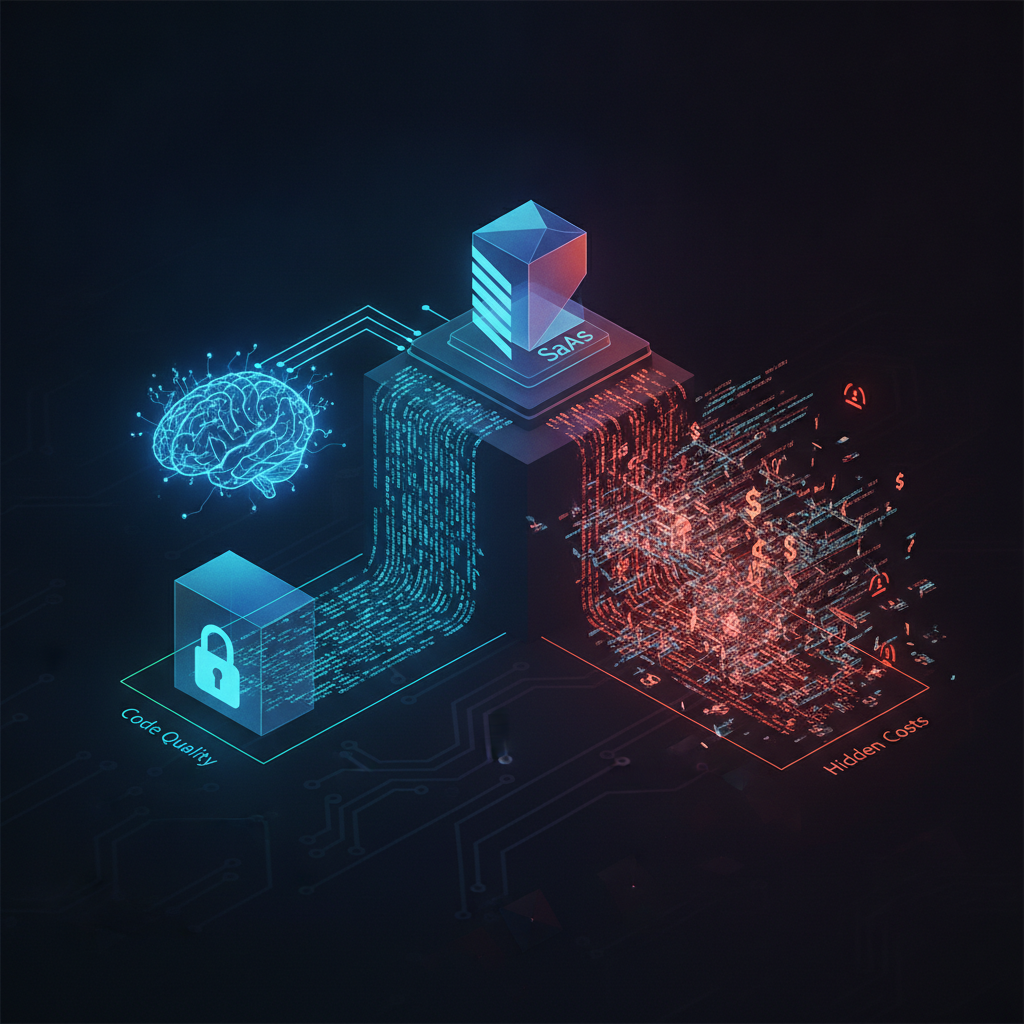
The Critical Imperative: Evaluating Code Quality and Modularity in AI Boilerplates
For any boilerplate, code quality is paramount, but for an AI SaaS boilerplate, it takes on an even greater significance. The complexity of AI integrations, combined with the rapid pace of model evolution, means that poorly written or tightly coupled code can quickly become an insurmountable obstacle. At BestSaaSBoilerplate.com, our independent code quality audits are designed to cut through marketing rhetoric and provide developers with a clear, evidence-backed understanding of what they are truly buying.
Many boilerplate vendors focus on showcasing a minimal viable product (MVP) with impressive AI features, but neglect the underlying architecture that supports long-term growth and adaptation. Our assessments, informed by Ryan Thompson's deep experience, reveal that a codebase might appear functional on the surface but harbor significant technical debt, making customization, debugging, and future upgrades prohibitively expensive. This is particularly true for AI components, where a lack of modularity can lead to complete architectural rewrites when models need to be swapped or data strategies change.
How Does an Independent Code Audit Evaluate AI SaaS Boilerplates?
An independent code audit, such as those conducted by BestSaaSBoilerplate.com, delves deep into the codebase to assess critical factors that directly impact long-term success. For AI SaaS boilerplates, our methodology focuses on several key areas:
Code Readability & Documentation: Is the code clean, well-structured, and adequately commented? Are AI-specific components clearly explained?
Architectural Modularity: Are the AI layers decoupled from the core SaaS components? Can individual AI models or services be swapped out without significant refactoring?
Test Coverage: Are the AI integration points, data pipelines, and model inference logic adequately tested? Lack of tests for AI components is a major red flag.
Performance & Efficiency: Is the AI code optimized for performance, especially for inference and data processing? Are there obvious bottlenecks?
Security Practices: How are API keys, model weights, and sensitive data handled? Are common security vulnerabilities addressed?
Dependency Management: Are AI libraries and frameworks managed effectively? Is there a clear path for dependency updates without breaking changes?
Scalability Considerations: Does the code demonstrate patterns that support horizontal scaling of AI services, or is it inherently monolithic?
These audits go beyond superficial checks, involving hands-on testing and rigorous code review to identify potential pitfalls that marketing materials would never disclose. Our goal is to provide transparency, empowering developers with the knowledge to make informed decisions that safeguard their project's future.
Identifying Technical Debt and Maintainability Risks
Technical debt in an AI SaaS boilerplate manifests in several ways, severely impacting maintainability. One common issue is the use of hardcoded configurations or direct API calls to specific AI services embedded deep within business logic. This creates tight coupling, making it difficult to switch providers or upgrade to newer AI models without extensive code modifications. A well-designed boilerplate would abstract these integrations behind interfaces or service layers, allowing for flexibility.
Another significant risk is the lack of clear separation between data science code and production-ready engineering code. Boilerplates sometimes include experimental or unoptimized AI scripts directly in the core application, leading to performance issues, stability problems, and difficulty in deploying robust MLOps practices. Ryan Thompson's assessments often highlight instances where boilerplate vendors prioritize quick functionality over long-term engineering best practices, leading to a codebase that is challenging to scale, secure, and debug.
Furthermore, poor error handling and logging within AI components can obscure critical issues. When an AI model fails or produces incorrect output, a robust boilerplate should provide clear, actionable logs and error messages, allowing developers to quickly diagnose and resolve problems. Without this, troubleshooting becomes a time-consuming guessing game, increasing operational costs and potentially impacting user trust. Identifying these subtle but critical indicators of technical debt is a core part of an independent evaluation, ensuring that developers aren't buying into a false economy.
Beyond the Hype: Addressing Vendor Lock-in and Long-Term Maintainability
The promise of speed from an AI SaaS boilerplate often comes at the cost of flexibility, particularly in terms of vendor lock-in. This is a critical concern for developers and technical founders who understand the long-term implications of being tied to a specific technology stack or service provider. As BestSaaSBoilerplate.com repeatedly highlights, true value comes from solutions that empower, not entrap, users. Our independent reviews rigorously test for the degree of lock-in, scrutinizing how easily components can be replaced or extended.
The fast-evolving nature of AI means that today's cutting-edge model could be obsolete tomorrow. If a boilerplate's AI integrations are deeply embedded and difficult to abstract, migrating to a new AI provider or model becomes an arduous, costly endeavor, potentially requiring a near-complete rewrite of significant portions of the application. This risk is often downplayed in marketing but constitutes a major liability for any long-term SaaS project. The average cost of a software migration project can range from $10,000 to over $100,000, depending on complexity (Source: Gartner, 2024 projections based on historical data).
What Are the Risks of Vendor Lock-in with AI SaaS Boilerplates, and How Can They Be Mitigated?
Vendor lock-in in AI SaaS boilerplates can manifest in several ways:
Proprietary AI Integrations: Boilerplates might use custom SDKs or frameworks that are tightly coupled to a specific cloud provider's AI services (e.g., AWS SageMaker, Google AI Platform, Azure ML). Switching providers means re-implementing these integrations from scratch.
Data Format & Storage Dependencies: The boilerplate might enforce specific data formats or rely on proprietary data storage solutions that make data extraction and migration challenging.
Custom Abstractions: While abstractions are good, overly complex or non-standard abstractions for AI services can create a new form of lock-in, making it difficult to understand or modify without deep knowledge of the boilerplate's unique patterns.
Limited Extensibility: A boilerplate that doesn't allow for easy injection of custom AI models or services limits future innovation and adaptation to unique business needs.
Mitigating these risks requires proactive evaluation. Look for boilerplates that emphasize open standards, provide clear interfaces for AI services, and allow for easy swapping of underlying AI models or providers. Prioritize solutions built on widely adopted frameworks and offer well-documented extension points. A truly robust AI SaaS boilerplate provides the groundwork, not the entire, immutable structure.
Strategies for Future-Proofing Your AI SaaS Application
Future-proofing an AI SaaS application built on a boilerplate involves several strategic considerations to ensure adaptability and longevity:
API-First AI Design: Ensure AI services are accessed through clear, versioned APIs. This decouples the AI logic from the application's core, allowing for independent updates.
Modular Architecture: Demand a boilerplate with a highly modular design for AI components. Each AI service (e.g., natural language processing, image recognition) should ideally be an independently deployable and swappable module.
Cloud Agnostic Principles: While often leveraging cloud services, the boilerplate should ideally demonstrate principles that make it adaptable to different cloud environments or even on-premise deployments, particularly for its AI components.
Data Portability: Ensure that data used by AI models can be easily exported and imported into other systems. Avoid proprietary data formats or storage solutions that create barriers to data mobility.
Continuous Learning & Monitoring: Implement robust MLOps practices for continuous model retraining and performance monitoring. This ensures your AI remains relevant and accurate, and the boilerplate should facilitate this, not hinder it.
Open Source & Community Support: While not always possible, boilerplates built on open-source foundations or with strong community support often offer greater transparency and flexibility in the long run.
Ryan Thompson's hands-on testing frequently uncovers that many boilerplates fail to meet these future-proofing criteria, forcing developers into costly refactoring later on. By prioritizing these strategies, developers can select an AI SaaS boilerplate that genuinely accelerates development without compromising long-term strategic flexibility.
Navigating Ethical AI, Data Privacy, and Security in Boilerplate Solutions
In the era of increasing regulatory scrutiny and public awareness, ethical AI, data privacy, and robust security are non-negotiable aspects of any SaaS application, especially one integrating artificial intelligence. An AI SaaS boilerplate must not only provide functional AI but also embody best practices for responsible AI deployment. Neglecting these areas can lead to significant reputational damage, legal liabilities, and erosion of user trust.
BestSaaSBoilerplate.com emphasizes that claims of "secure" or "compliant" AI integrations must be rigorously verified. Many boilerplates offer generic security features for the SaaS core but often overlook the unique challenges posed by AI, such as model bias, data leakage from training sets, or adversarial attacks on inference endpoints. Ryan Thompson's expertise highlights that a boilerplate's value is diminished if it creates more compliance or security headaches than it solves.
Implementing Responsible AI Practices
Responsible AI practices are critical for building trustworthy and sustainable AI SaaS applications. A high-quality boilerplate should offer foundational elements that support these practices:
Bias Detection & Mitigation: Tools or frameworks to help identify and address biases in training data and model predictions. This is crucial for fair and equitable AI outcomes.
Transparency & Explainability (XAI): Features that enable understanding how an AI model arrives at its decisions, allowing for greater accountability and trust. Boilerplates should provide hooks or integrations for XAI libraries.
Fairness & Accountability: Architectural patterns that promote fairness in AI outputs and provide clear audit trails for AI-driven decisions.
Human Oversight & Intervention: Mechanisms to allow human intervention in critical AI-driven processes, preventing fully autonomous, potentially harmful decisions.
Robustness & Reliability: Code designed to withstand unexpected inputs or adversarial attacks, ensuring the AI performs reliably in diverse real-world scenarios.
These are not optional extras; they are fundamental requirements for any AI system deployed in production, especially those impacting users directly. The National Institute of Standards and Technology (NIST) has released an AI Risk Management Framework, which serves as a guiding principle for responsible AI development (Source: NIST, 2023). A boilerplate should align with such frameworks.
Data Governance and Compliance Frameworks
Data privacy and security are inextricably linked to AI. Any AI SaaS boilerplate handling personal or sensitive data must incorporate robust data governance and compliance frameworks. This includes:
GDPR, CCPA, and Other Regulatory Compliance: The boilerplate should provide features that facilitate compliance with major data privacy regulations. This includes consent management, data access request handling, and data anonymization/pseudonymization tools.
Secure Data Handling: Data used for AI training and inference must be encrypted both at rest and in transit. Access controls must be granular, ensuring only authorized personnel and services can interact with sensitive data.
Audit Trails & Logging: Comprehensive logging of data access, model inferences, and administrative actions is vital for auditing, debugging, and demonstrating compliance.
Incident Response Capabilities: The underlying infrastructure and code should support rapid identification and response to data breaches or security incidents related to AI components.
Privacy-Preserving AI Techniques: (Advanced) Consideration for techniques like federated learning or differential privacy, especially for models trained on highly sensitive distributed datasets.
Ryan Thompson's experience shows that boilerplate vendors often provide boilerplate security for the non-AI parts, but leave the complex, AI-specific data security and privacy challenges entirely to the developer. An independent review platform like BestSaaSBoilerplate.com specifically examines how well these critical AI-centric concerns are addressed, ensuring that developers are not left exposed to significant legal and ethical risks.
Choosing Wisely: An Independent Framework for AI SaaS Boilerplate Selection
Selecting an AI SaaS boilerplate is a strategic decision that can dictate the future trajectory of your SaaS product. Given the complexities and potential pitfalls, a robust, independent evaluation framework is essential. BestSaaSBoilerplate.com exists precisely for this purpose: to provide evidence-backed assessments that cut through marketing hype and offer transparency into code quality, maintenance, lock-in, honesty of claims, and support. Our approach is founded on hands-on testing and a commitment to not using affiliate links or paid rankings, ensuring unbiased information.
Developers, technical founders, and engineering teams must adopt a critical mindset, moving beyond feature lists to scrutinize the underlying architecture and long-term implications. Ryan Thompson's extensive background in SaaS development underpins the understanding that the cheapest or fastest boilerplate upfront can quickly become the most expensive and time-consuming to maintain. The real cost of a boilerplate isn't its purchase price, but the total cost of ownership over its lifecycle.
Due Diligence: Beyond Marketing Claims
Effective due diligence for an AI SaaS boilerplate involves a multi-faceted approach:
Code Review (if possible): Request access to the codebase. Look for clear structure, modularity, test coverage, and adherence to best practices, especially within AI components. Pay attention to how AI models are integrated, versioned, and deployed.
Vendor Transparency: Evaluate the vendor's honesty regarding limitations, dependencies, and future roadmap. Are they open about how their AI integrations work? Do they provide clear documentation for customization?
Community & Support: Assess the activity level of the boilerplate's community (if open source) or the responsiveness and quality of vendor support. A strong support system is invaluable when navigating complex AI challenges.
Testimonials & Case Studies: Look for independent reviews and testimonials, ideally from users with similar technical requirements and long-term aspirations. Be wary of overly generic or vendor-controlled success stories.
Trial & Evaluation: Whenever possible, undertake a proof-of-concept (PoC) with the boilerplate. Deploy a small AI feature, attempt a customization, and test the ease of integrating your own models or data. This hands-on experience is invaluable.
Pricing & Licensing: Understand the full pricing model, including potential costs for underlying cloud services, AI APIs, and ongoing maintenance or support. Scrutinize licensing terms for any restrictions on modification or distribution.
This rigorous process, advocated by BestSaaSBoilerplate.com, is designed to uncover the real strengths and weaknesses of an AI SaaS boilerplate, protecting your investment and ensuring long-term project viability. Investing time in this upfront evaluation significantly reduces the risk of costly rework and frustration down the line.
The Role of Support and Community
The quality of support and the vibrancy of the community surrounding an AI SaaS boilerplate are often underestimated but are critical factors in its long-term success. For complex AI integrations, encountering issues is inevitable. The ability to quickly find answers, get assistance, or collaborate with other developers can be the difference between rapid problem resolution and prolonged development delays.
A boilerplate with excellent documentation, active forums, and responsive vendor support provides a safety net. This is particularly important for AI components, where debugging can be highly specialized. Ryan Thompson's experience underscores that a boilerplate's true value is not just in its initial features, but in the ongoing ecosystem that enables developers to overcome challenges and adapt the product over time. Lack of clear documentation or an unresponsive support team for AI-specific issues is a significant red flag, indicating that developers may be left to navigate complex problems alone.
Conversely, boilerplates that foster a strong community often benefit from collaborative improvements, shared best practices, and quicker bug fixes. This collective knowledge base becomes an invaluable resource, extending the boilerplate's utility far beyond what a single vendor could provide. When selecting an AI SaaS boilerplate, prioritize solutions where help is readily available, whether through official channels or an engaged user base.
Conclusion: Building the Future of AI SaaS with Informed Decisions
The landscape of AI-driven SaaS development is rapidly expanding, and AI SaaS boilerplate solutions offer a compelling pathway to accelerate product launch. However, the initial allure of "out-of-the-box" AI must be tempered with a rigorous, independent evaluation focused on long-term viability, code quality, and the true cost of ownership. The insights from BestSaaSBoilerplate.com and the expertise of Tech Review Specialist Ryan Thompson consistently reveal that many boilerplates overpromise on ease and undersell the complexities of sustainable AI integration.
Developers and technical leaders must look beyond superficial features, scrutinizing architectural modularity, extensibility, and the potential for vendor lock-in. Prioritizing robust data pipelines, comprehensive model management, and unwavering adherence to ethical AI, data privacy, and security standards is paramount. The strategic selection of an AI SaaS boilerplate is not merely a technical choice; it is a critical business decision that will define your product's adaptability, scalability, and compliance in a dynamic market.
By employing a framework of deep due diligence, informed by independent assessments and a commitment to understanding the true implications of each component, you can harness the power of AI SaaS boilerplates to build truly innovative, resilient, and future-proof applications. Choose wisely, and empower your team to focus on unique value creation, rather than untangling avoidable technical debt.
Frequently asked questions

Written by
Ryan Thompson
Tech Review Specialist
Ryan Thompson has over a decade of experience working in software development, with a deep focus on SaaS platforms. He covers SaaS boilerplates because he understands the challenges developers face when selecting the right foundation for their projects. Ryan emphasizes hands-on testing and transparency to provide truly independent, evidence-backed assessments.
Holds a Bachelor's degree in Computer Science from UCLA and has 10 years of experience in software development and product management.
View all articles by Ryan Thompson →